
Splitting shared land in Jordan: partition and ending co-ownership
Published · 6 min read
- property
- land
- guide
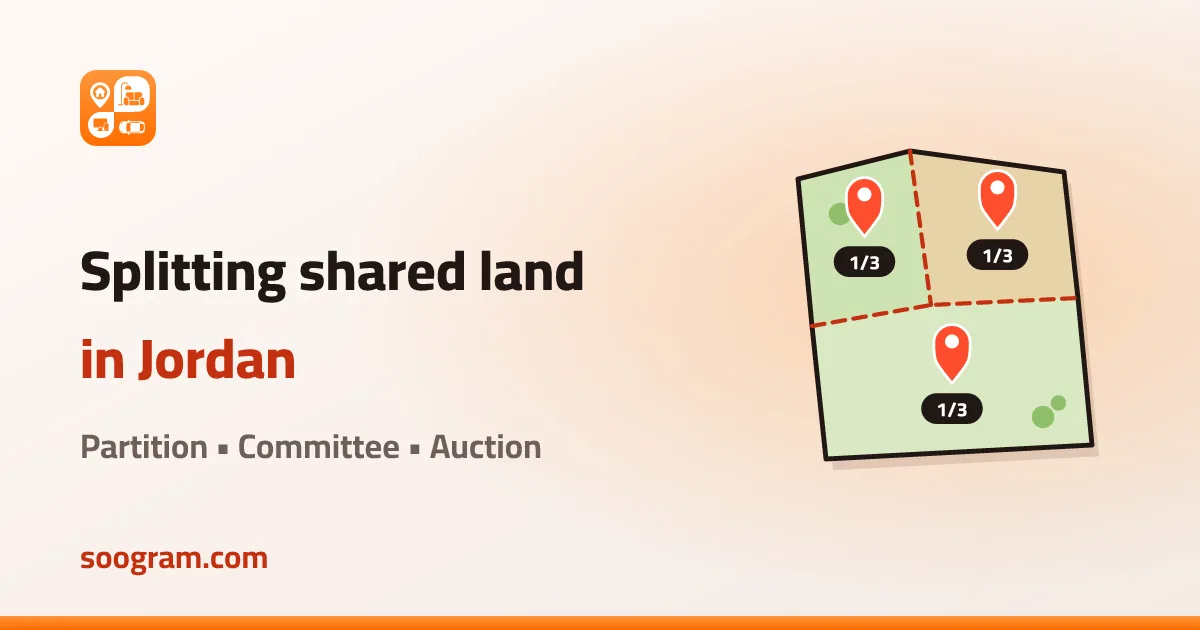
Inherited land with your brothers and sisters? Bought a share of a plot with relatives? That land is held in common (shuyou’): each partner owns a percentage of the whole plot, not a specific piece of it. So nobody can build on “their part” or sell it on its own as a separate plot. The way out is ending the co-ownership (izalat al-shuyou’): either the shares become separate plots, each with its own title deed, or the land is sold and the money is split.
Note: this is a plain summary of general information from Jordan’s Real Estate Ownership Law No. 13 of 2019 and its amendments. Fees and details change, and every plot is different. Before you act, ask the land registration directorate your plot belongs to, or a specialist lawyer.
Co-ownership, subdivision, partition: what’s the difference?
- Held in common: one plot, one title deed, with the partners registered on it by shares. For example, three siblings with a third each.
- Subdivision (ifraz, or farz): splitting the plot into smaller plots on a survey plan, each with its own number and deed.
- Ending co-ownership: either by partition (subdividing and giving each partner a plot) or by selling the whole plot and dividing the price by shares.
You have the right to ask for partition
The law is clear: any partner may ask for the property to be partitioned, and the other partners cannot refuse. There are two exceptions:
- If all partners agree to postpone partition, the delay cannot exceed 5 years. An agreement to stay in common indefinitely does not stop anyone from asking.
- If the purpose the property is set aside for requires it to stay shared.
Route one: agreed partition (fastest and cheapest)
When every partner agrees on how to split, the whole transaction happens at the Department of Lands and Survey:
- Agree who gets which part. Partition is by value, not by square metre: a plot on the main road is worth more than a back plot of the same size. If you cannot agree on values, the registration director sets them.
- Hire a licensed surveyor to draw the partition plan on the ground.
- Get the plan approved by the planning authority (the municipality, Greater Amman Municipality, or the relevant planning committee). The department will not register a partition whose plans have not been approved.
- Partners or their agents attend the registration directorate to confirm the partition and pay the fees.
- New title deeds are issued: each partner gets a separate plot.
Route two: the partition committee (when partners can’t agree)
Before 2019, ending co-ownership was a court case that could take years. Today the request goes to the land registration director for your plot, who refers it to the Committee for Ending Co-ownership of Real Estate. The committee sits in the registration directorate, includes a legal officer and a surveyor, and is the only body that hears these requests.
How a request moves:
- File the request. A note goes on the plot’s register saying a partition request is pending, and the other partners are notified. If one has died, their heirs are notified.
- Site inspection: the committee visits with an expert who values the land and checks it matches the register.
- Decision:
- If the partners’ shares can be divided, meaning their use is not lost by dividing them, the land is partitioned and each partner gets a plot. Differences in value are settled in cash.
- If the shares cannot be divided, there is first an auction among the partners, at no less than the expert’s valuation. If no partner buys, the land is sold at public auction through the court’s enforcement department, opening at no less than 75% of the committee’s valuation. The price is then split by shares.
- Appeal: the committee’s decision can be challenged at the Court of First Instance within 30 days, and the court’s decision is final.
- Enforcement: a partition decision is recorded directly in the land register; a sale decision is carried out by the enforcement department.
Costs: fees are charged under the court fees regulation, and each partner pays the costs of ending co-ownership in proportion to the value of their share.
What if most partners want to sell?
If not everyone agrees to sell, owners of at least three quarters of the shares may ask the committee to sell. The partners who refused are notified and state their position in writing, and the land cannot be sold below the price the committee sets. That price holds for up to a year, after which a new valuation can be requested.
Can your land be subdivided at all?
Ask this first, because no partition can override zoning rules:
- Inside zoned areas, each zone has a minimum plot size and street frontage depending on its class (Residential A, B, C, D, commercial, agricultural…).
- Outside zoned areas, agricultural land also has a minimum (commonly quoted as 4 dunums per plot). Check the rule for your specific plot.
Example: if the minimum in your zone is 500 m² and the plot is 900 m² shared by three partners, it cannot be split into three plots. The way forward then is for one partner to buy out the others, or to sell the land.
Ask the municipality or Greater Amman Municipality for a zoning site plan of your plot before you agree on anything.
Documents you’ll usually need
- The partners’ IDs, or a clear power of attorney for anyone not attending. If you live abroad, you can issue one at the Jordanian embassy or consulate in your country.
- A recent title deed and land plan for the plot.
- If the land is inherited: an inheritance certificate (hasr irth), then an inheritance transfer so the shares are registered in the heirs’ names first.
- A clearance from the municipality (property and land taxes) when asked.
- The partition plan from a licensed surveyor, for an agreed partition.
Costly mistakes
- Building before partition. Whatever you build on shared land becomes an issue with every partner, and may end up in the partition or the sale.
- “Buying” a specific piece of shared land on paper outside the Lands Department. The seller does not own a specific square metre to sell, and ownership only passes by registration.
- Assuming partition is by area. It is by value; location and frontage make a big difference.
- Ignoring seizures or mortgages. If a partner’s share carries a seizure or mortgage note, it moves onto the plot that partner receives.
- Waiting for someone else to start. Every year the number of heirs can grow, shares get smaller, and agreement gets harder.
A last word
Start by talking to your partners. An agreed partition is much faster and cheaper, and it keeps the family on good terms. If you cannot agree, the committee is a formal route with clear steps. Just find out first whether your land can be subdivided, and roughly what your share is worth.
Selling land or an apartment, or looking for one? On Soogram you post your listing in the property section with photos, area and price, and interested buyers message you inside the app. Download the app from the App Store or Google Play. If you run a real estate office, open your store on Soogram.